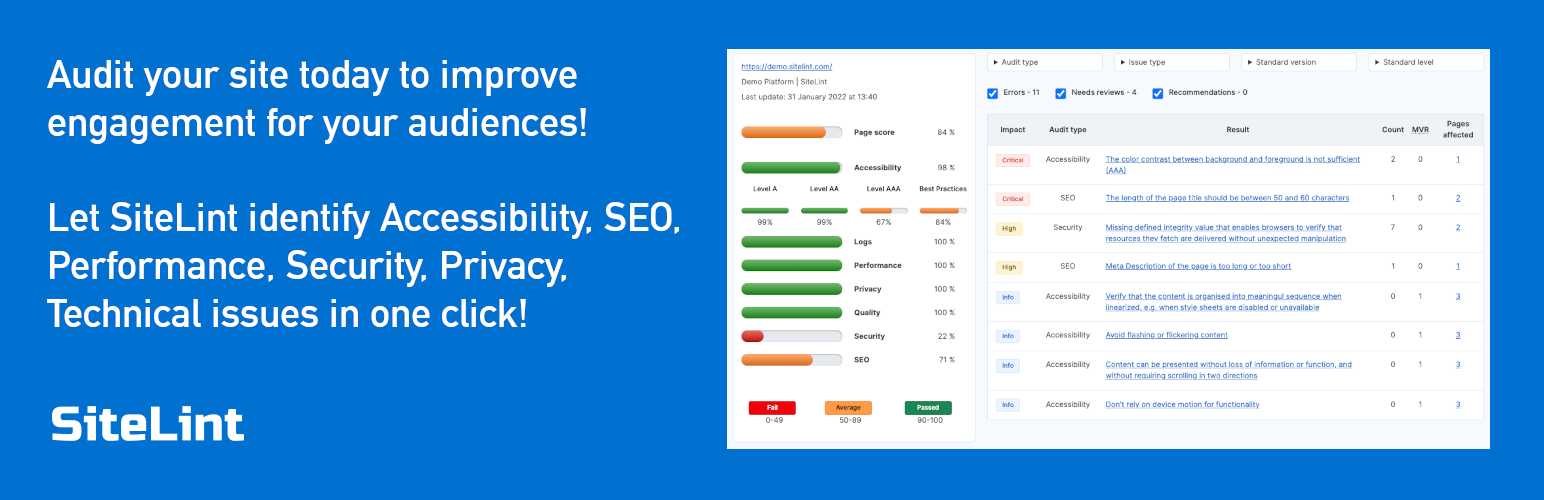
SiteLint – Web Audit Tools Security & Risk Analysis
wordpress.org/plugins/sitelintClient-side & real-time checker for Accessibility, SEO, Performance, Security, Privacy, Technical issues.
Is SiteLint – Web Audit Tools Safe to Use in 2026?
Generally Safe
Score 100/100SiteLint – Web Audit Tools has no known CVEs and is actively maintained. It's a solid choice for most WordPress installations.
The sitelint plugin v1.5.24 exhibits a strong security posture based on the provided static analysis. The absence of any identified AJAX handlers, REST API routes, shortcodes, or cron events with unprotected entry points significantly reduces the potential attack surface. Furthermore, the code signals indicate no dangerous functions are used, all SQL queries are properly prepared, and there are no identified taint flows with unsanitized paths or critical/high severity. This suggests a conscientious development approach to core security principles.
However, there are areas for improvement. The output escaping is only 68% proper, meaning a portion of user-generated content or dynamic output may be vulnerable to cross-site scripting (XSS) attacks if not handled carefully by themes or other plugins. The absence of nonce checks and capability checks on all entry points, though the entry points are currently zero, represents a potential future risk if functionality is added without proper security measures. The plugin also performs file operations and external HTTP requests, which, while not inherently insecure, warrant careful review to ensure these operations are not exploitable.
Given the complete lack of any historical vulnerabilities or CVEs, this plugin appears to be well-maintained and secure. The current static analysis does not reveal any critical or high-risk issues. The primary area of concern is the imperfect output escaping, which, while not a direct vulnerability in the plugin itself without a specific exploit path, is a weakness that could be leveraged in conjunction with other factors. Overall, sitelint v1.5.24 demonstrates a good security foundation but has room for refinement in output sanitization.
Key Concerns
- Improper output escaping
- No nonce checks on entry points
- No capability checks on entry points
SiteLint – Web Audit Tools Security Vulnerabilities
SiteLint – Web Audit Tools Release Timeline
SiteLint – Web Audit Tools Code Analysis
Output Escaping
Data Flow Analysis
SiteLint – Web Audit Tools Attack Surface
WordPress Hooks 4
Maintenance & Trust
SiteLint – Web Audit Tools Maintenance & Trust
Maintenance Signals
Community Trust
SiteLint – Web Audit Tools Alternatives

Editoria11y Accessibility Checker
editoria11y-accessibility-checker
Content accessibility checker written to be intuitive and useful for non-technical authors and editors.

Auto Image Title & Alt
auto-image-title-alt
Automatically adds title and alt tags to new images in the media library, improving SEO and accessibility with customizable fields and capitalization.

HealthSpark Site Health Dashboard
healthspark
Your site's vital signs — all in one dashboard. Monitor accessibility, performance, security, SEO health, and EU compliance.

Repolog
repolog
Audit your site's SEO, speed, security, accessibility, and AI readiness — scores and top fixes right inside the WordPress dashboard.

ScoreFix – Boost Lighthouse & Improve UX
scorefix
Fix the issues hurting your Lighthouse score and conversions in one click. No coding required.
SiteLint – Web Audit Tools Developer Profile
2 plugins · 20 total installs
How We Detect SiteLint – Web Audit Tools
Patterns used to identify this plugin on WordPress sites during automated security audits and web crawling.
Asset Fingerprints
/wp-content/plugins/sitelint/admin/css/styles.css/wp-content/plugins/sitelint/admin/scripts/app.js/wp-content/plugins/sitelint/public/css/sitelint-public.css/wp-content/plugins/sitelint/public/scripts/sitelint-public.jsadmin/scripts/app.jspublic/scripts/sitelint-public.jssitelint/admin/css/styles.css?ver=sitelint/admin/scripts/app.js?ver=sitelint/public/css/sitelint-public.css?ver=sitelint/public/scripts/sitelint-public.js?ver=HTML / DOM Fingerprints
sitelint-noticesitelint-main-blocksitelint-main-block__headersitelint-main-block__itemsitelint-main-block__item-labelsitelint-main-block__item-valuesitelint-main-block__listsitelint-main-block__list-header+2 more<!-- BEGIN SiteLint --><!-- END SiteLint --><!-- SiteLint: SiteLint -->data-sitelint-option-namedata-sitelint-option-valuedata-sitelint-item-namedata-sitelint-item-valuesitelintPublic/wp-json/sitelint/v1/settings/wp-json/sitelint/v1/report